Which Bitcoin price a prediction market actually uses
Kalshi and Polymarket both list hourly Bitcoin markets, and they do not read the same price. Kalshi averages sixty seconds of the CF Benchmarks Bitcoin Real-Time Index. Polymarket reads the close of one Binance BTC/USDT candle. On a fast-moving minute, those are different numbers.
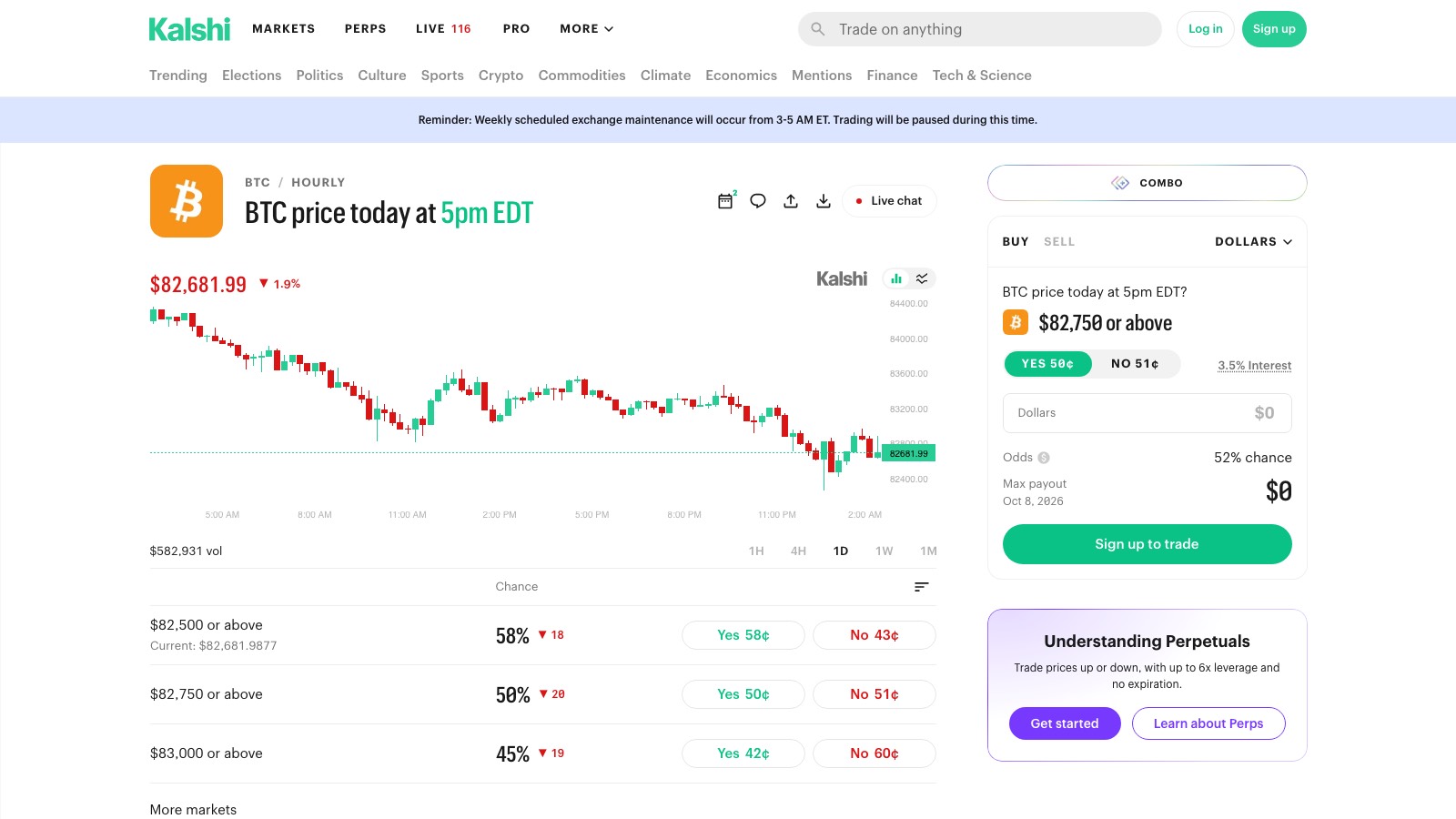
Kalshi's rule
A live hourly market states it plainly:
If the simple average of the sixty seconds of CF Benchmarks' Bitcoin Real-Time Index (BRTI) before 2 AM EDT is above 95299.99 at 2 AM EDT on Oct 7, 2026, then the market resolves to Yes.
The contract terms define the underlying:
Underlying: The Underlying for this Contract is the spot price of one Bitcoin in U.S. dollars at , according to a simple average of the CF Bitcoin Real-Time Index (“BRTI”) for the minute (60 seconds) prior to . Revisions to the Underlying made after Expiration will not be accounted for in determining the Expiration Value.
And the market text warns you off the price on your screen:
Not all cryptocurrency price data is the same. While checking a source like Google or Coinbase may help guide your decision, the price used to determine this market is based on CF Benchmarks' corresponding Real Time Index (RTI). At the last minute before expiration, 60 RTI prices are collected. The official and final value is the average of these prices.
Polymarket's rule
Polymarket's equivalent hourly market resolves on an exchange candle, not an index:
This market will resolve to "Yes" if the "Close" price for the BTC/USDT 1 hour candle that ends on the time and date specified in the title is higher than the price specified in the title. Otherwise, this market will resolve to "No". The resolution source for this market is Binance, specifically the BTC/USDT "Close" prices currently available at https://www.binance.com/en/trade/BTC_USDT with "1h" and "Candles" selected on the top bar. Please note that this market is about the price according to Binance BTC/USDT, not according to other exchanges or trading pairs. Price precision is determined by the number of decimal places in the source.
Its daily markets use the Binance one-minute candle closing at noon Eastern time.
If the price feed fails
Kalshi's terms answer the outage question directly:
If no data is available on the Expiration Date at the Expiration Time, then the market resolves to No.
The expiry itself moves with the data:
Expiration Date: The Expiration Date of the Contract shall be the sooner of the first minute after on that data is available or one week after .

