What Kalshi actually charges
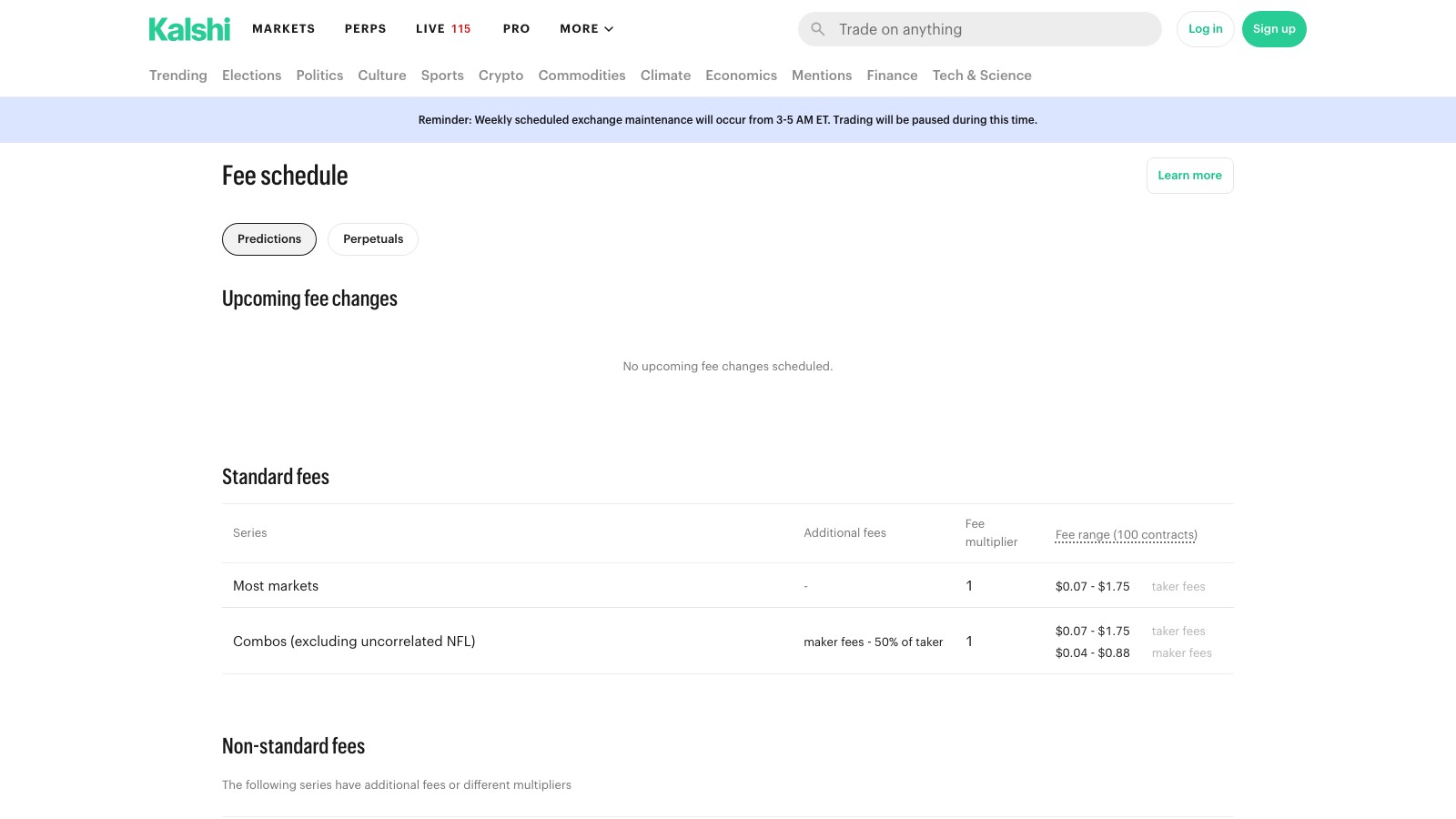
Kalshi's help centre does not tell you what Kalshi charges. It says the exchange takes "a transaction fee on the expected earnings on the contract" and points at a PDF. This page uses the PDF, Kalshi's fee-schedule page and the exchange's own API, which between them say considerably more than the help pages do, including that makers pay a fee on 163 series, which is the opposite of what the rest of the category does.
The two formulas
The fee schedule publishes two, not one:
taker: fees = round_up(M * rate * C * p * (1-p))
maker: fees = round_up(M * 0.0175 * C * p * (1-p))
P is the contract price, C the number of contracts, M a multiplier that is 1 by default for takers and 0 by default for makers. So on most markets a maker pays nothing, but "by default" is doing real work in that sentence, and the exchange sets M per series.
The standard taker rate is 0.07. The maker rate, where it applies, is 0.0175, a quarter of the taker rate.
At 50¢ for 100 contracts the standard taker fee is $1.75.
Kalshi rounds up, and it costs you a cent
Kalshi's standard rate is 0.07, the same constant as Polymarket's crypto tier. The two venues are not the same price, because Kalshi rounds up to the cent and Polymarket rounds to nearest.
Both publish a table. They disagree at exactly the prices where rounding bites:
| Price | Polymarket crypto | Kalshi standard | Differs |
|---|---|---|---|
| $0.01 | $0.07 | $0.07 | |
| $0.05 | $0.33 | $0.34 | yes |
| $0.10 | $0.63 | $0.63 | |
| $0.15 | $0.89 | $0.90 | yes |
| $0.20 | $1.12 | $1.12 | |
| $0.25 | $1.31 | $1.32 | yes |
| $0.30 | $1.47 | $1.47 | |
| $0.35 | $1.59 | $1.60 | yes |
| $0.40 | $1.68 | $1.68 | |
| $0.45 | $1.73 | $1.74 | yes |
| $0.50 | $1.75 | $1.75 | |
| $0.55 | $1.73 | $1.74 | yes |
| $0.60 | $1.68 | $1.68 | |
| $0.65 | $1.59 | $1.60 | yes |
| $0.70 | $1.47 | $1.47 | |
| $0.75 | $1.31 | $1.32 | yes |
| $0.80 | $1.12 | $1.12 | |
| $0.85 | $0.89 | $0.90 | yes |
| $0.90 | $0.63 | $0.63 | |
| $0.95 | $0.33 | $0.34 | yes |
| $0.99 | $0.07 | $0.07 |
It is one cent per hundred contracts, which sounds like nothing until you notice it always favours the exchange and applies to every trade you make. Kalshi's formula does say "round up"; what it does not spell out is that, for an ordinary account, the balance is settled to the cent, so the cent is what you pay.
Makers pay on 163 series
Polymarket says plainly that makers are never charged. Novig says maker fills are free "no matter the market or trade type". Kalshi publishes a maker rate of 0.0175 and applies it wherever a series sets the maker multiplier above zero.
Reading the fee structure of all 14,698 series from the exchange's own API gives 6 distinct shapes:
| Fee type | Multiplier | Series | What they are |
|---|---|---|---|
quadratic |
1 | 14,503 | the standard schedule |
quadratic_with_maker_fees |
1 | 159 | makers pay at the standard maker rate (Sports 106, Science and Technology 21, Financials 13, Economics 10) |
quadratic |
0.5 | 18 | half rate (Sports 18) |
quadratic |
0 | 14 | fee-free (Politics 5, Economics 3, Elections 3, Crypto 2) |
quadratic_with_combo_maker_fees |
1 | 3 | combos: makers pay half the taker rate (Exotics 3) |
quadratic_with_maker_fees |
0.5 | 1 | makers pay, both rates halved (Sports 1) |
So 98.7% of series are on the standard schedule, and the other 1.3% is not random.
What the help centre says about this, and what the data shows
Kalshi's fees article explains the variation like this:
"Some markets have fees that are different from those of other markets. This is often due to special events (such as the election, awards ceremony, or a large sporting championship)."
The data is broader than "special events". Of the 163 maker-fee series, 107 are sports, and most of those are routine, recurring products: regular-season NBA, NFL, MLB and WNBA game markets, plus league futures. The other 56 are standing macro and finance series (the Fed decision, CPI, jobs, GDP, gas prices, index ranges) and a run of GPU rental-price series. Combo markets have their own maker fee at half the taker rate, except combos built only from independent NFL games, which carry none. The half-rate series are MLB props: strikeouts, total bases, hits, runs and RBIs.
A trader reading the help centre would conclude maker fees are an occasional
oddity attached to marquee events. In practice they attach to a fixed and
growing list of ordinary markets. Kalshi's fee-schedule page at
kalshi.com/fee-schedule lists non-standard series with their multipliers (157
of them when we read it on 6 October 2026, fewer than the API reports, so treat
the API as the complete list); the help article does not send you there.
The fee-free series
14 series charge nothing at all:
- DOE eliminated
- Gambling Repeal
- Greenland purchase
- Annual GDP
- BTC price range EOY
- Will Pahlavi lead Iran?
- Tech layoffs
- Trump Out As President
- Greenland, Panama, Canada control
- ETH price EOY
- Will Iran hold a presidential election?
- Will Iran become a democracy in 2026?
- Who will be Khamenei's successor?
- Will the Citrini scenario materialize?
A civic-and-macro cluster, which echoes Polymarket making its geopolitics markets fee-free. Neither exchange explains the choice.
How Kalshi compares
Per 100 contracts at 50¢, across venues that all price on the same curve:
| Venue and trade type | Fee per 100 at 50¢ |
|---|---|
| Novig, pre-game straight | $0.00 |
| Polymarket, sports outright (live, undocumented) | $0.75 |
| Novig, live in-game straight | $0.75 |
| Robinhood, either tier (capped) | $1.00 |
| Polymarket, sports / economics | $1.25 |
| Kalshi, standard taker | $1.75 |
| Polymarket, crypto | $1.75 |
| Robinhood, including exchange fee | $2.00 |
| Novig, parlay | $2.50 |
Kalshi sits at the expensive end on the headline rate, but it has no cap and no separate exchange fee, which is what makes Robinhood, routing to Kalshi, dearer still once its exchange fee is added. See Robinhood fees.
Two things worth knowing
The fee schedule is the source, not the help centre. The rates on this page
come from kalshi.com/docs/kalshi-fee-schedule.pdf, and kalshi.com/fee-schedule
lists non-standard series with their multipliers. The help article states no
rate at all.
Kalshi announces fee changes before they happen. The fee-schedule page has an
"upcoming fee changes" section, the API exposes the same thing as a
series/fee_changes feed, and every change is self-certified to the CFTC as a
public filing before it takes effect. Every series also links its CFTC product
certification, the filing that actually governs the contract you are trading.


