What Robinhood charges for event contracts
Robinhood describes its event contract commission as probability-weighted: you pay more on a coin-flip than on a near-certainty, because a coin-flip is worth more to the exchange. That is true of the formula and false of the charge, because Robinhood also caps the commission at a cent per contract, and the cap binds across most of the range where people actually trade. This page computes both, from Robinhood's own published table. There is a second fee, absent from the commission table, that roughly doubles the cost of a trade at the money. Any comparison that omits it flatters Robinhood into looking like the cheapest venue on the board.
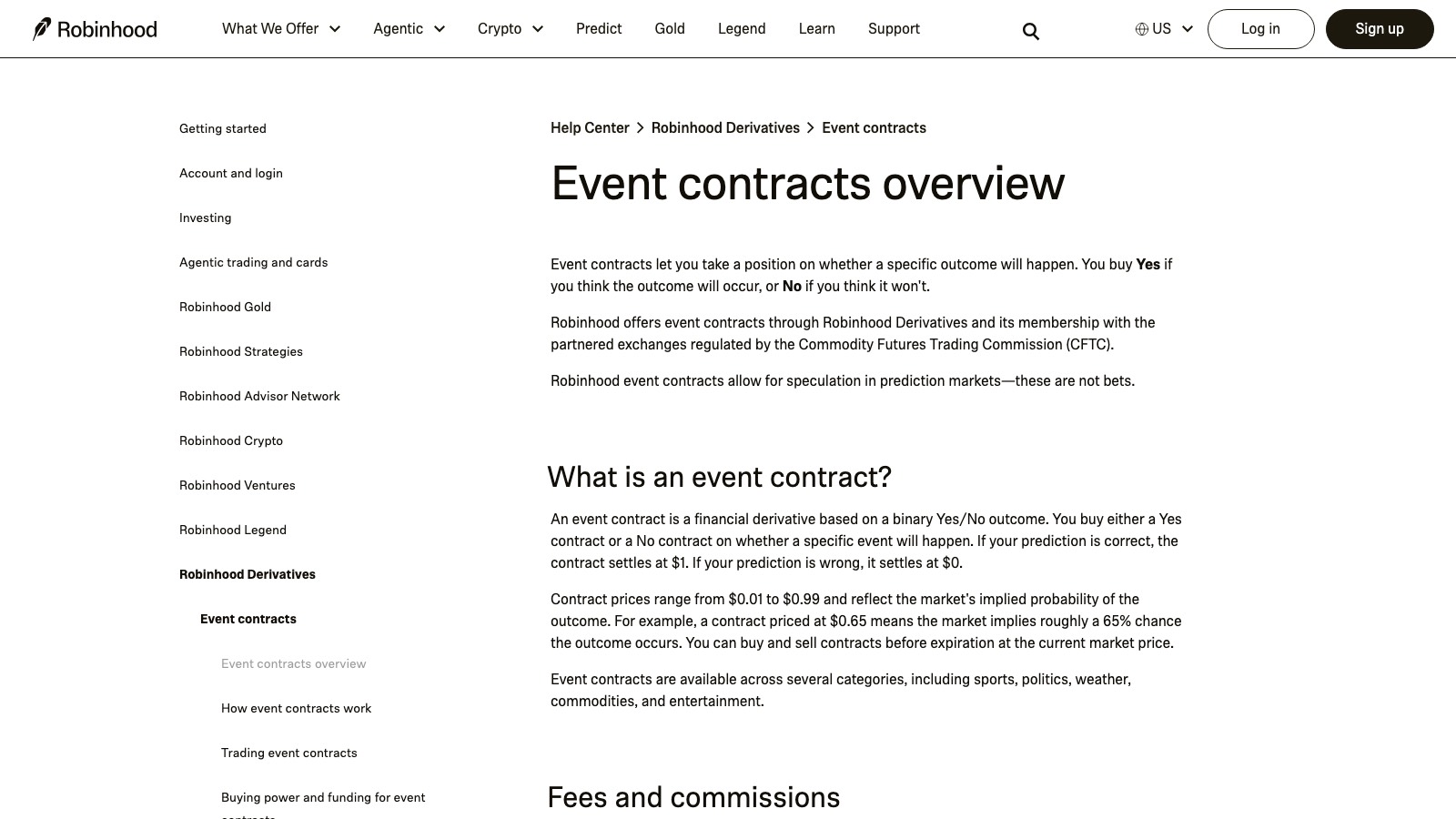
The formula is the category's formula
Robinhood publishes it as:
commission = min(k * p * (1-p) * c, cap * c)
p is the contract price, c the number of contracts, and k the rate:
0.1 without Robinhood Gold, 0.05
with it.
Set that beside Polymarket's fee = C × rate × p × (1 − p) and Novig's
Fee = Coefficient × Price × (1 − Price) × Number of contracts and it is the
same curve with a different letter. k is exactly Polymarket's per-category
rate. Robinhood Gold at 0.05 is priced on the same constant
as Polymarket's sports and economics tier, see
Polymarket fees.
So the formula is never the difference between venues. What Robinhood bolts onto it is.
The cap is the page
Robinhood caps the commission at one cent per contract. Solve
k × p × (1 − p) = cap and you get the band where the cap, not the curve,
decides what you pay:
| Tier | Cap binds between | Share of the 1¢ to 99¢ range |
|---|---|---|
| No Gold (k = 0.1) | 0.113 to 0.887 | ~77% |
| Gold (k = 0.05) | 0.276 to 0.724 | ~45% |
For a trader without Gold, across roughly three-quarters of the 1¢ to 99¢ range the commission is not probability-weighted at all. It is a flat cent a contract. The headline describes a curve; the charge is that curve clipped flat exactly through the middle of the book, which is where most volume sits.
This is not an inference from the formula. Robinhood publishes the flat band itself, as $0.28 to $0.72, and the band computed from its own rate and cap is the same interval rounded to cents. The venue and the arithmetic agree.
Gold buys nothing at the money
Both tiers hit the same cap, so above a certain volume of probability the cheaper rate makes no difference whatsoever:
| Price | No Gold | Gold | Gold saves |
|---|---|---|---|
| $0.01 | $0.10 | $0.05 | $0.05 |
| $0.05 | $0.48 | $0.24 | $0.24 |
| $0.10 | $0.90 | $0.45 | $0.45 |
| $0.15 | $1.00 * | $0.64 | $0.36 |
| $0.20 | $1.00 * | $0.80 | $0.20 |
| $0.25 | $1.00 * | $0.94 | $0.06 |
| $0.30 | $1.00 * | $1.00 * | $0.00 |
| $0.35 | $1.00 * | $1.00 * | $0.00 |
| $0.40 | $1.00 * | $1.00 * | $0.00 |
| $0.45 | $1.00 * | $1.00 * | $0.00 |
| $0.50 | $1.00 * | $1.00 * | $0.00 |
| $0.55 | $1.00 * | $1.00 * | $0.00 |
| $0.60 | $1.00 * | $1.00 * | $0.00 |
| $0.65 | $1.00 * | $1.00 * | $0.00 |
| $0.70 | $1.00 * | $1.00 * | $0.00 |
| $0.75 | $1.00 * | $0.94 | $0.06 |
| $0.80 | $1.00 * | $0.80 | $0.20 |
| $0.85 | $1.00 * | $0.64 | $0.36 |
| $0.90 | $0.90 | $0.45 | $0.45 |
| $0.95 | $0.48 | $0.24 | $0.24 |
| $0.99 | $0.10 | $0.05 | $0.05 |
* = the per-contract cap is binding at that price.
Between roughly 30¢ and 70¢, a Gold subscription saves zero commission. Gold pays for itself only on longshots and near-certainties, the prices at which the uncapped curve is still below the cap for one tier and not the other.
That is a concrete answer to a question the marketing does not address: if you trade mostly close-run events, the subscription is not buying you cheaper contracts. It may be worth having for its other benefits. It is not worth having for this one.
The exchange fee, which is not in the commission table
The commission is not the whole charge. Robinhood passes on a separate exchange fee of up to a cent per contract, charged on both opening and closing trades. It is not in the commission table: the Derivatives Fee Schedule puts the KalshiEx fee at $.01 per contract, per side and says exchange fees vary by product. The event contracts overview page mentions it in one sentence below the formula, "Exchanges typically charge an additional fee, which varies by exchange and can be up to $0.01 per contract", and its worked example adds a $0.01 exchange fee to the total.
Per 100 contracts at 50¢, across venues that all price on the same curve:
| Venue and trade type | Fee per 100 at 50¢ |
|---|---|
| Novig, pre-game straight | $0.00 |
| Polymarket, sports outright (live, undocumented) | $0.75 |
| Novig, live in-game straight | $0.75 |
| Robinhood, either tier (capped) | $1.00 |
| Polymarket, sports / economics | $1.25 |
| Kalshi, standard taker | $1.75 |
| Polymarket, crypto | $1.75 |
| Robinhood, including exchange fee | $2.00 |
| Novig, parlay | $2.50 |
Read the commission alone and Robinhood is mid-table and looks cheap for a retail app. Add the exchange fee Robinhood itself discloses and it costs more than every line on that list except Novig's parlay. Both numbers are Robinhood's; only the commission is in the table most people read.
Robinhood is a broker, and it does not run the market
This is the fact that reframes everything above. Robinhood's own documentation states that event contracts are offered by Robinhood Derivatives, LLC through KalshiEX LLC, ForecastEX, LLC or Rothera Exchange and Clearing LLC, or North American Derivatives Exchange, Inc. That is four venues, and the fourth was added after our 30 August 2026 snapshot of the page.
Three consequences follow:
- You may be trading a Kalshi contract. If your order routes to KalshiEX you are exposed to the same exchange, the same settlement rules and the same litigation as a direct Kalshi user. See Kalshi fees.
- Which venue fills you decides the exchange fee. "Up to $0.01 per contract" is a ceiling across four different venues' schedules, not one rate, and the exchange-fee note on Robinhood's fee schedule does not name the fourth venue.
- The comparison above is between a broker and the exchanges it routes to. Robinhood's commission sits on top of an exchange's own economics.
Deliberately not asserted: whether the Kalshi exchange fee a Robinhood order incurs is Kalshi's published schedule or a separately negotiated rate. Robinhood says only "up to $0.01 per contract" and points at its own fee schedule; the relationship between the two documents is not stated by either party. We are not going to guess at it, because a guess here would change the total cost of a trade.
Where you cannot trade this
Robinhood's overview page also carries broker-level restrictions that have nothing to do with the federal cases against the exchanges:
"Maryland and Nevada residents can't trade sports event contracts. Michigan residents can’t open new sports event contracts as of September 9, 2026. Additional state restrictions may apply. Check the app for the most current list of supported states."
None of Maryland, Nevada or Michigan is among the states the CFTC is currently litigating against. State availability is therefore being decided in two independent places, federal litigation over the exchanges, and the broker's own rules, and a page tracking only the court cases gives a Maryland reader the wrong answer.
Robinhood's own advice is to check the app for the current list. That is a fair admission that any published list, including this one, goes stale. Ours carries a date; treat the app as authoritative on the day you trade.

