Who the markets say wins the House and Senate in 2026
Kalshi and Polymarket both price party control of the House and the Senate after the November 2026 midterms. At 11:38 UTC on 11 October 2026, Kalshi priced Democratic Party at 90.1¢ and Polymarket priced Democratic Party at 90.5¢.
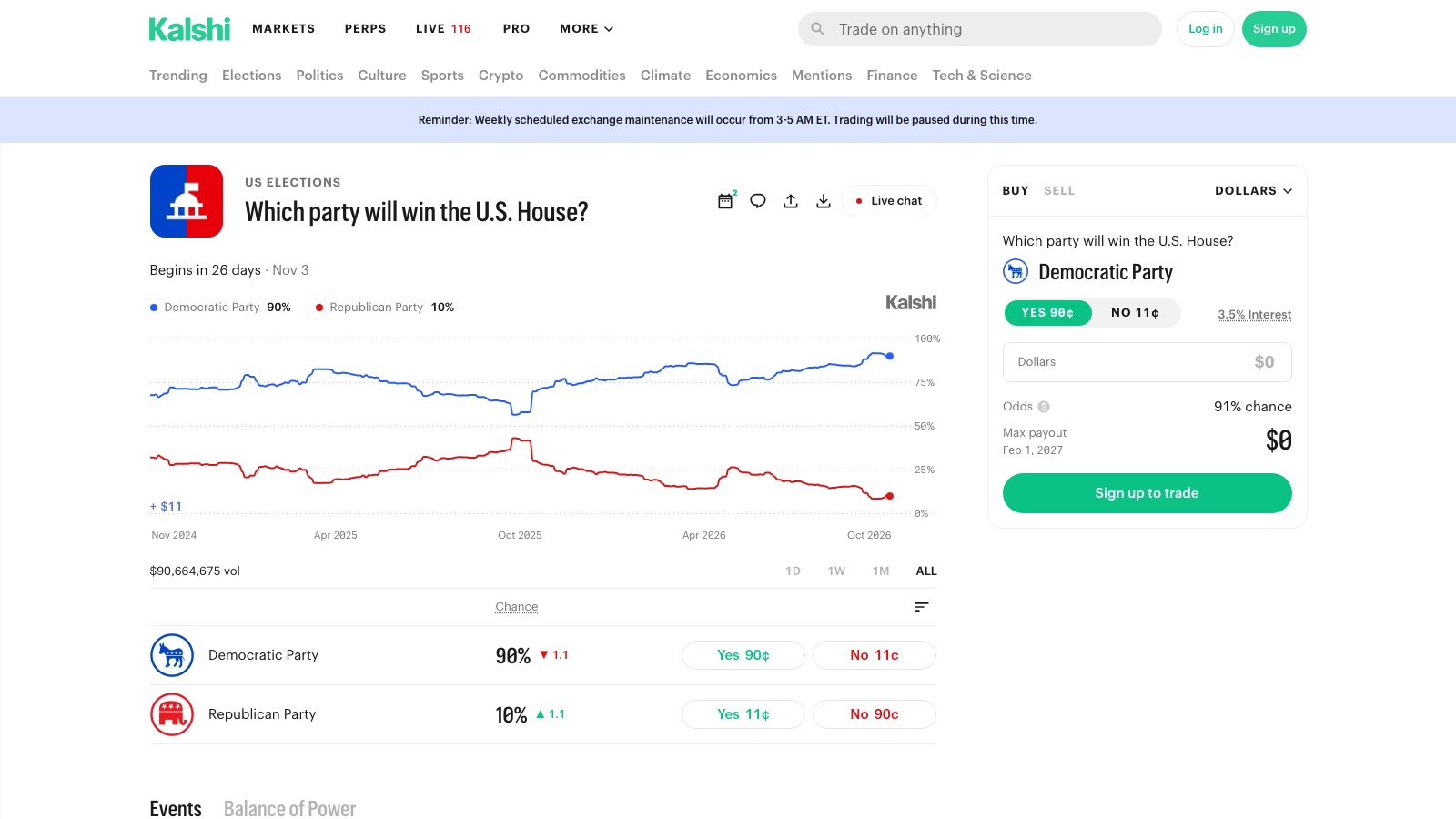
Which party will win the U.S. House?: prices at 11:38 UTC
Kalshi: Which party will win the U.S. House?, closes 1 Feb 2027. Polymarket: Which party will win the House in 2026?, closes 4 Nov 2026.
| Outcome | Kalshi | Polymarket | Difference |
|---|---|---|---|
| Democratic Party | 90.1¢ | 90.5¢ | 0.4 pts |
| Republican Party | 11¢ | 9.5¢ | 1.5 pts |
Which party will win the U.S. Senate?: prices at 11:38 UTC
Kalshi: Which party will win the U.S. Senate?, closes 1 Feb 2027. Polymarket: Which party will win the Senate in 2026?, closes 4 Nov 2026.
| Outcome | Kalshi | Polymarket | Difference |
|---|---|---|---|
| Democratic Party | 60¢ | 62.5¢ | 2.5 pts |
| Republican Party | 40¢ | 36.5¢ | 3.5 pts |
How each venue resolves it
Kalshi states the rule on each contract. For Democratic Party:
If the Democratic Party has won control of the House in 2026, then the market resolves to Yes.
Polymarket's market description:
This market will resolve according to the party that wins control of the United States House of Representatives in the 2026 United States midterm election.
A party wins control of the United States House of Representatives if it wins a majority of the chamber’s voting seats. If no party wins a majority of voting seats, the chamber will be deemed controlled by the party with which the first elected Speaker of the House of the Congress that convenes after the 2026 midterm election is affiliated.
The following rules govern the counting of seats for determining which party wins control of the chamber.
All House elections in the 2026 United States midterm election that elect voting members and determine representation in the upcoming 120th Congress are included. Where a seat is decided by a runoff, the runoff result will determine attribution of that seat.
A price on one venue is a price on its own rule. Where the wording differs, a gap between the two prices can be the rule, not a mistake.
What a trade costs
Both venues charge a fee that is largest near 50¢ and shrinks toward 1¢ and 99¢. The exact rates, by category, are on our Kalshi fees and Polymarket fees pages, and whether you can trade at all depends on your state.
About these prices
Prices are the last traded price on Kalshi's public market API and the displayed price on Polymarket's Gamma API, both read at 11:38 UTC on 11 October 2026. They move all day; open the market on the venue for the price now.

