Arbitrage between Kalshi and Polymarket: what the gaps leave after fees
Cross-venue arbitrage means buying Yes on one venue and No on the other when the two prices add up to less than $1, so one side pays whichever way it resolves. The quoted gaps are small: at 11:38 UTC on 11 October 2026, the widest on a market both venues list was 4.5 points, on Oklahoma City Thunder in 2027 Pro Basketball Champion.
How it works
Cross-venue arbitrage means buying Yes on one venue and No on the other when the two prices add up to less than $1, so one side pays whichever way it resolves. If Kalshi prices Yes at 40¢ and Polymarket prices No at 55¢, the pair costs 95¢ and one contract pays $1, a 5¢ edge before fees. In practice the edge is usually smaller than the fees and the rule differences below.
The gaps at 11:38 UTC
The quoted gaps are small: at 11:38 UTC on 11 October 2026, the widest on a market both venues list was 4.5 points, on Oklahoma City Thunder in 2027 Pro Basketball Champion.
Per 100 contracts on each side. The Kalshi fee is its taker fee on the Kalshi leg (0.07 x C x P x (1 - P), rounded up to the cent); Polymarket's leg carries its own fee, which depends on the market's category, so the last column is an upper bound. It is an upper bound for a second reason: the table compares Kalshi's last traded price with Polymarket's displayed price, and neither is a price you can fill at. A real pair of orders pays the asking price on both venues, which usually narrows the gap or closes it.
| Market | Outcome | Kalshi | Polymarket | Buy | Gross edge | Kalshi fee | Before Polymarket's fee |
|---|---|---|---|---|---|---|---|
| 2027 Pro Basketball Champion | Oklahoma City Thunder | 23¢ | 18.5¢ | Yes on Polymarket | $4.50 | $1.24 | $3.26 |
| 2028 Democratic presidential nominee | Alexandria Ocasio-Cortez | 14¢ | 17.9¢ | Yes on Kalshi | $3.85 | $0.85 | $3.00 |
| Which party will win the U.S. Senate? | Republican Party | 40¢ | 36.5¢ | Yes on Polymarket | $3.50 | $1.68 | $1.82 |
| 2027 Pro Basketball Champion | New York Knicks | 9¢ | 12.5¢ | Yes on Kalshi | $3.50 | $0.58 | $2.92 |
| Which party will win the U.S. Senate? | Democratic Party | 60¢ | 62.5¢ | Yes on Kalshi | $2.50 | $1.68 | $0.82 |
| 2027 Pro Basketball Champion | Miami Heat | 6¢ | 3.8¢ | Yes on Polymarket | $2.25 | $0.40 | $1.85 |
| 2027 Pro Basketball Champion | Philadelphia 76ers | 13¢ | 11.1¢ | Yes on Polymarket | $1.95 | $0.80 | $1.15 |
| 2028 Democratic presidential nominee | Andy Beshear | 5.2¢ | 3.4¢ | Yes on Polymarket | $1.80 | $0.35 | $1.45 |
| 2027 Pro Football Champion | Baltimore Ravens | 6¢ | 7.7¢ | Yes on Kalshi | $1.65 | $0.40 | $1.25 |
| 2027 Pro Basketball Champion | San Antonio Spurs | 21¢ | 22.5¢ | Yes on Kalshi | $1.50 | $1.17 | $0.33 |
Prices from the live market pages, read at 11:38 UTC on 11 October 2026; fees from Kalshi fees and Polymarket fees.
Same question, different rule
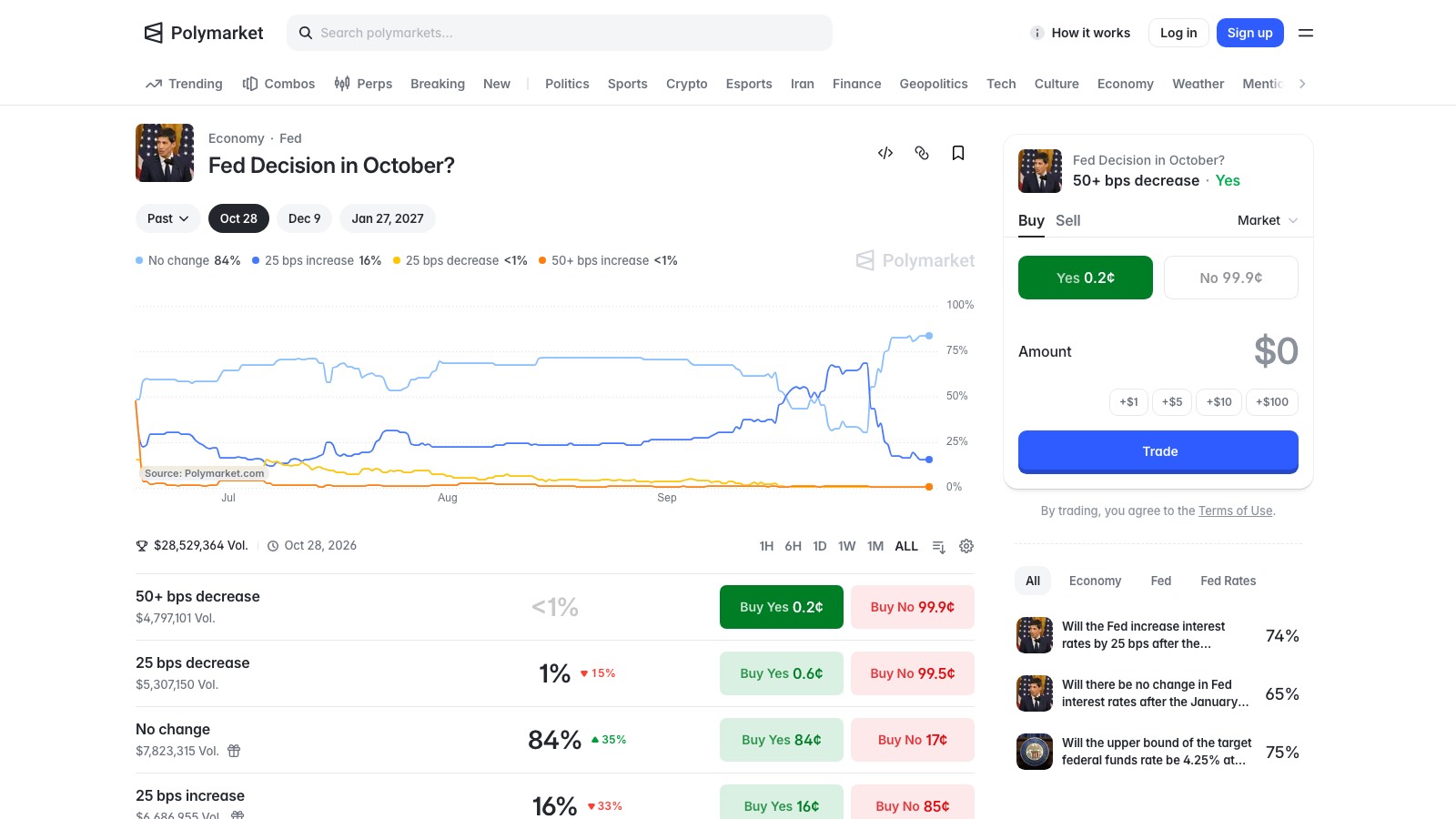
The two venues do not always resolve on the same rule. For the same October 2026 Fed meeting, Polymarket rounds an off-menu move up to the next 25 basis points, while Polymarket US rounds to the nearest option.
If the target federal funds rate is changed to a level not expressed in the displayed options, the change will be rounded up to the nearest 25 and will resolve to the relevant bracket.
changes greater than the smallest option of the same direction will be rounded to the nearest displayed option, with values exactly halfway between options being rounded away from zero.
Kalshi's source:
Source Agency: The Source Agency is the Federal Reserve System.
Expiration Value: The Expiration Value is the value of the Underlying as documented by the Source Agency on the Expiration Date at the Expiration time.
And if the meeting is cancelled, the venues need not agree:
If the scheduled FOMC meeting is canceled and does not occur on its scheduled date, “Fed maintains rate” resolves to Yes and all other outcomes resolve to No.
If no statement is released by the end date of the next scheduled meeting, this market will resolve to the "No change" bracket.
The rules that apply
Both venues ban wash trading and orders that do not change who owns the position, and Kalshi limits retail users to one account.
No Person shall engage in any trading activity intended to accomplish a “money pass”, “wash trade” or “front-running” as such terms are defined by the Commission and any regulations promulgated thereunder.
On Kalshi, users are restricted to trading with only a single account to ensure the integrity and security of the trading environment.
(v) wash trading (e.g., placing or accepting any buy and sell order in the same contract, where you know or reasonably should know that the purpose of the orders is to avoid taking a bona fide market position exposed to market risk);
A Participant (including through any of its Authorized Users) must not intentionally match, directly or indirectly, an Order it has placed or caused to be placed in any other capacity or account, including but not limited to the Participant’s own direct account and any intermediated, managed, or commonly controlled account(s).
Position limits cap the size: The Position Accountability Level for the $1 referred Contract shall be $25,000 per Member. on Kalshi's Fed contract, and Polymarket US caps a single market buy:
a single market buy is limited to $1,000,000
Polymarket's international site resolves through UMA, not a rulebook:
all Contracts displayed on the Platform are resolved by the UMA Optimistic Oracle, a smart contract based optimistic oracle in accordance with a Contract’s pre-defined rules.
What the venues and the CFTC say
We found no Kalshi, Polymarket or CFTC statement on arbitrage between Kalshi and Polymarket in particular. Kalshi's own explainer covers arbitrage in general and warns:
Risks of Arbitrage Trading Arbitrage trading is not without risk.
"We have a zero tolerance policy when it comes to any sort of manipulative trading, including wash trading, insider trading, or fraud in our markets," CFTC Chairman Michael Selig said in an appearance on CNBC's " Squawk on the Street " on Sept. 23.
Whether you can hold an account on each venue at all depends on your state.

