Kalshi sign-up bonus, why nobody can tell you the amount
Kalshi has a referral programme, and unlike Polymarket it uses real codes you type in at sign-up. What it does not have is a published bonus amount. Kalshi states the reward, the trading requirement and the lifetime cap only inside your own account, and says in its own FAQ that all three "depend on the program that applies to your account". That is the answer to "how much is the Kalshi sign-up bonus", and it has an uncomfortable consequence: every page quoting you a specific dollar figure is stating a number Kalshi does not publish. It might be right for the person who wrote it. There is no basis for it being right for you. What Kalshi does publish is a set of hard rules about how the credit behaves once you have it, and most of those rules cost people the bonus.
What Kalshi publishes, and what it withholds
| Published? | |
|---|---|
| That a referral programme exists | ✅ |
| How to find and enter a code | ✅ |
| The window for entering one late | ✅ |
| That credits expire, and how fast | ✅ |
| That credits are not withdrawable | ✅ |
| The bonus amount | ❌ in-app only |
| The trading requirement to unlock it | ❌ in-app only |
| The lifetime earnings cap | ❌ in-app only |
Kalshi's phrasing on the amount:
"Referral reward amounts depend on the program that applies to your account. To see the current reward for your account, open Menu → Referrals in the app or check your Rewards section."
And on the cap:
"Yes. There's a lifetime cap on total referral earnings. You can see your progress toward the cap, and the cap amount that applies to your account, in the Rewards section of the app."
Compare that with Novig, which publishes in plain text that your friend gets $50 in Trade Credits and you get five $10 Referral Credits, that the qualifying deposit is $10, and that you can be paid for up to five referrals. Same category, same month, opposite disclosure posture.
The 72-hour rule, which is where most bonuses are lost
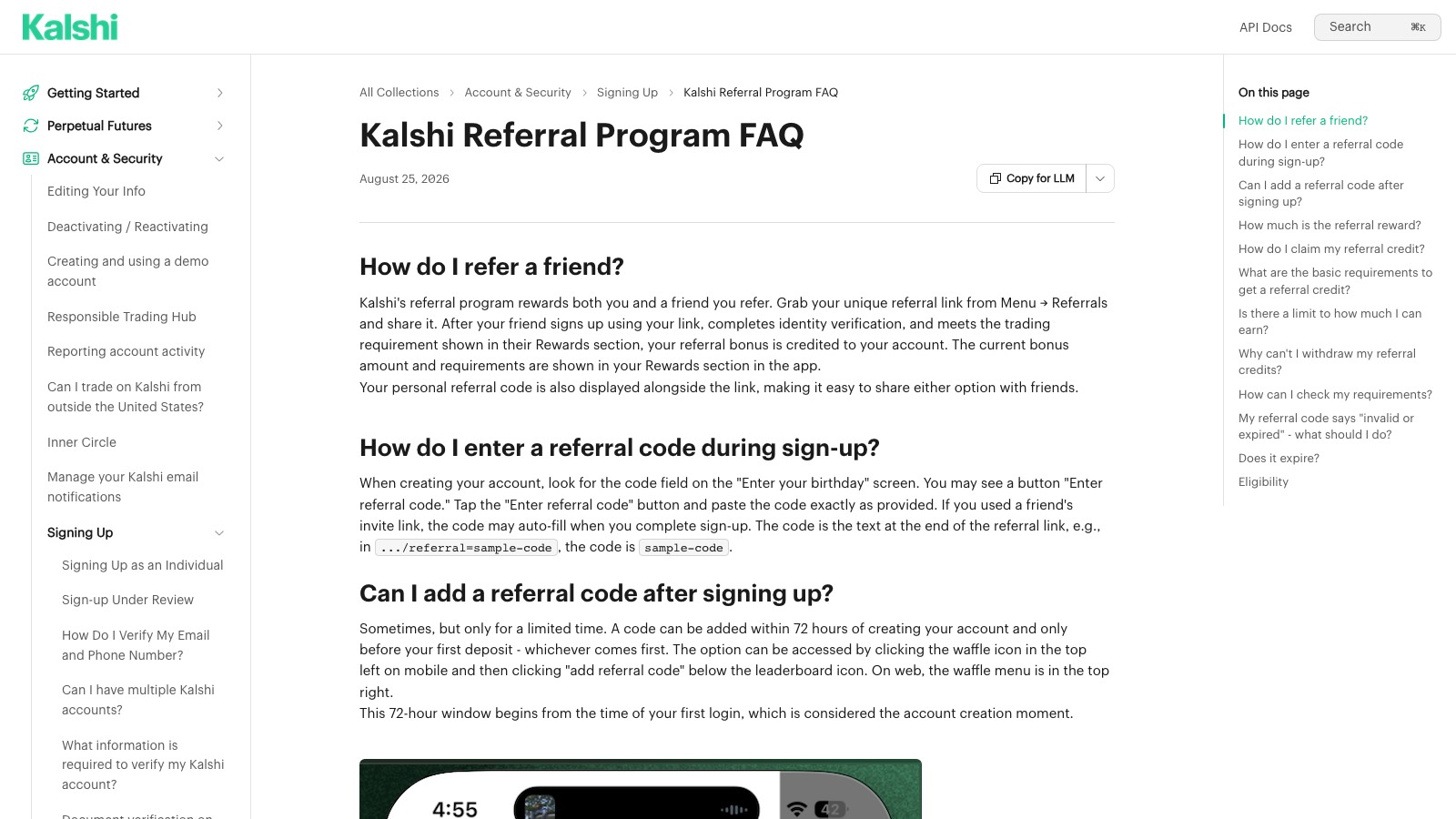
You can enter a code during sign-up, on the "Enter your birthday" screen. If you miss it, there is a second chance with two conditions, and Kalshi is precise about both:
"A code can be added within 72 hours of creating your account and only before your first deposit, whichever comes first."
The clock starts at your first login, which Kalshi treats as the moment of account creation. So the common failure is not slowness, it is depositing first. Fund the account before entering the code and the window has closed, regardless of how much of the 72 hours is left.
Three more rules that are final:
- Once applied, a code cannot be changed or replaced.
- Once the window closes, a code cannot be added retroactively. Kalshi says it "cannot be reissued, reinstated, or extended under any circumstances".
- Codes are fixed to an account and cannot be regenerated. If a friend's code returns "invalid or expired", asking them for a fresh one will not help, either it has genuinely expired or their account is not eligible to refer.
The credit is not money
This is the part that changes what the bonus is worth, whatever its size:
"Referral credits aren't cash, they're designed for trading on the platform. Only the profits you make from using referral credits become withdrawable cash. The original referral amount itself usually isn't withdrawable."
And it has a short life:
"Referral credits issued by Kalshi must be used within 7 days of issuance, unless otherwise specified, or they will be forfeited."
Seven days, no reinstatement. So the realistic value of a Kalshi bonus is not its face amount, it is whatever profit you can make by deploying it inside a week, on an exchange that charges a taker fee of 0.07 on the way in. See Kalshi fees for what that costs, and Kalshi withdrawals for getting the resulting profit out.
US only. Kalshi states that "referral incentives are only available to U.S. users at this time. International users are not eligible."
You must also complete KYC. An unverified account earns no credit.
The programme that pays more than the bonus
For anyone trading with size, Kalshi's referral bonus is the smallest of its incentives. The one standing programme Kalshi's help centre still documents pays against activity, and it works as a partial offset to the fees on our Kalshi fees page.
The Liquidity Incentive Program pays for resting orders that improve the book, "even if your orders don't get filled". Kalshi scores it by snapshotting the order book once per second, at a random moment within each second, and weighting your resting size by its distance from a Reference Price that is recomputed for every snapshot rather than fixed in advance. Active reward periods are marked on market pages, and Kalshi says it "can end or modify the program at any time". The help article currently shows a programme end date of January 1, 2027.
The article lists who cannot take part: Kalshi affiliates and employees, Introducing Brokers and FCMs and their customers, and non-US users.
The Volume Incentive Program is no longer documented. Kalshi used to describe a cashback programme of that name, paid from a reward pool. The help article that carried its terms now returns Kalshi's "That page doesn't exist" error, and the help centre's Programs & Promotions collection no longer lists it. We cannot source its pool size, its share formula or its eligible price range any more, so this page no longer quotes any of them. We do not know whether the programme itself has ended or only its article has been removed, so if you see a volume reward offered in the app, read the terms shown there.
Note what the surviving programme is, structurally. A trader earning liquidity rewards is being paid to post exactly the resting orders that Kalshi charges a maker fee on across 163 of its series, 107 of them sports, and nothing on the rest. See Kalshi fees for which series those are. The incentive programme and the fee schedule are the same ledger read from opposite ends, and only one end is advertised.
Perps promotions are a different product
Kalshi's perpetual futures product has its own promotions, separate from the prediction-market referral programme. If you have seen a Kalshi offer that pays credit for trading a set amount in perps, that is the perpetual futures product, not prediction markets. Kalshi's perps article no longer gives any dollar example of such an offer. It says offers are not always available to every user and that "amounts differ between campaigns", and points you to the terms shown in the app or email for the offer that applies to you.
Kalshi lists two kinds today. Perps referral rewards pay you a share of a referred friend's trading fees, weekly, once that friend enables perps and completes the qualifying activity, and the friend gets a discount on their own fees. Survey and feedback credits are offered by email for completing a survey or interview.
The crucial mechanical detail:
"Perps promo credits are added to your perps account, they will not appear in your predictions balance… Credits themselves cannot be withdrawn, winnings from trading with them can be."
Balances do not move between the two products in either direction. A perps credit cannot be spent on an event contract. This mirrors Polymarket, where Perps is likewise a separate product with its own invite codes, in both cases the "code" people find in search results belongs to the perpetuals product, not the prediction market.
So what should you actually do
- Enter a code at sign-up, not after. The second window is real but it is the shorter of 72 hours and your first deposit, and depositing is the step most people take first.
- Do not plan around a figure you read anywhere, including here. Open Menu → Referrals and read your own reward, requirement and cap.
- Diarise the seven days. An unused credit is forfeited with no recourse.
- If you trade regularly, look at the Liquidity Incentive Program rather than the sign-up bonus. It rewards ongoing activity rather than a one-off sign-up, though Kalshi can end or modify it at any time.